The research side, from the inside
In one lineThe research that later defined this subject was built in a room with its own recruitment chain, contracts and payments.
Witness account · Arturo TafoyaI was part of these events. Where I appear, I tell it in the first person; every document is stamped the same way as the rest of the file.
Chapter 12 traced how the academic paper entered through Rauhauser's recruitment chain. This chapter is what the room looked like once it was running: who sat in it, who was paid, who signed what, and what happened to the person whose archive it was built on.
"Axis of QAnon" — five members, one PR director
An encrypted Wire group: Laura Dilley, Claudia Tietze (Farallon LLC), William Welna, a member called "Erie," and me. The export shows the division of labour plainly. Farallon directs — archiving, media strategy, coaching Dilley on PR, interviews and a TED talk. Dilley supplies the academic credential. Welna and Dilley discuss Section 230 and publisher liability.
On November 14 — before the paper is published — the group is already in a litigation-anticipatory posture: a channel "for each of the possible litigants," talk of who gets named, who is hardest to serve, how to delay. The litigant they anticipated then was Trevor Fitzgibbon, not Schoenberger. The same export has the group discussing mass-reporting an opponent to get him suspended, with the instruction to "get everything archived first."
The "folklore basket": Farallon describes QAnon as a design
Dilley's book manuscript introduces a "Cambridge Analytica inquiry intelligence expert" as friend and mentor (Ch. 3). That person is Claudia Tietze, and in a recorded conversation with Dilley she describes early QAnon as an ARG built on legend tripping: a visceral first-person abuse story is posted, others add their own, and each contribution goes into shared "folklore baskets" until the fiction is an interconnected legend. The Democrats-and-adrenochrome layer, she says, came later — "Version 2, or three, or four."
She describes testing the pizza-emoji trigger herself (any tweet with it drew a bot swarm, then real accounts), and on origins offers: "I wondered if it wasn't SCL related" — SCL being Cambridge Analytica's parent.
Every line here is her assertion, provably made. The SCL remark is speculation with no evidence offered, and it is filed as speculation. What the recording does establish is how precisely the research side's director could describe the participatory design — and that this framing was being supplied to the academic, not arrived at by her.
The DADA Project: built on one man's archive, with no line for him
The Defense Against the Dark Arts (DADA) Project, PI Dr. Laura Dilley, proposes an archive of interviews, a tagged public database of "rare media clips," and a promotional campaign. The background section states my role in its own words:
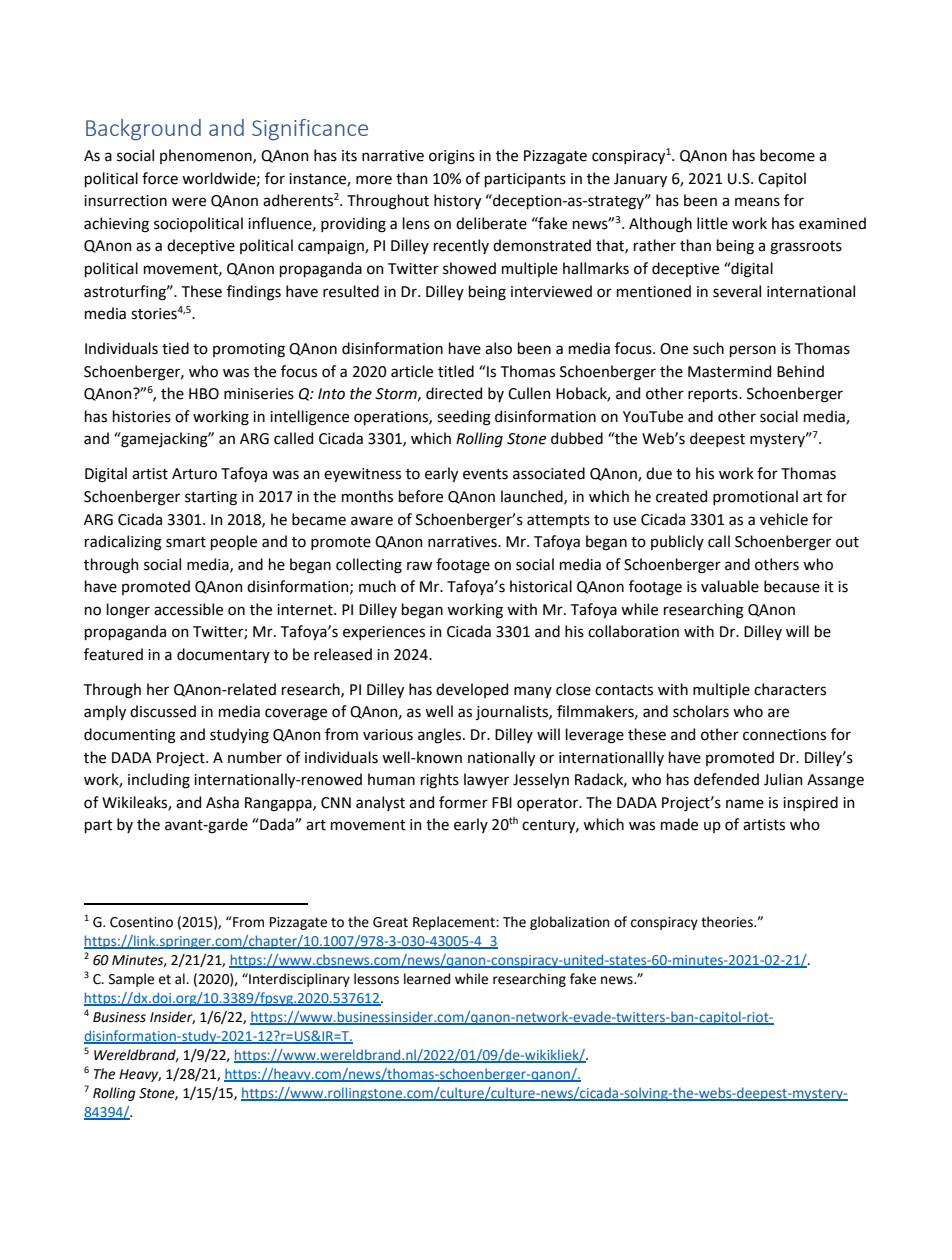
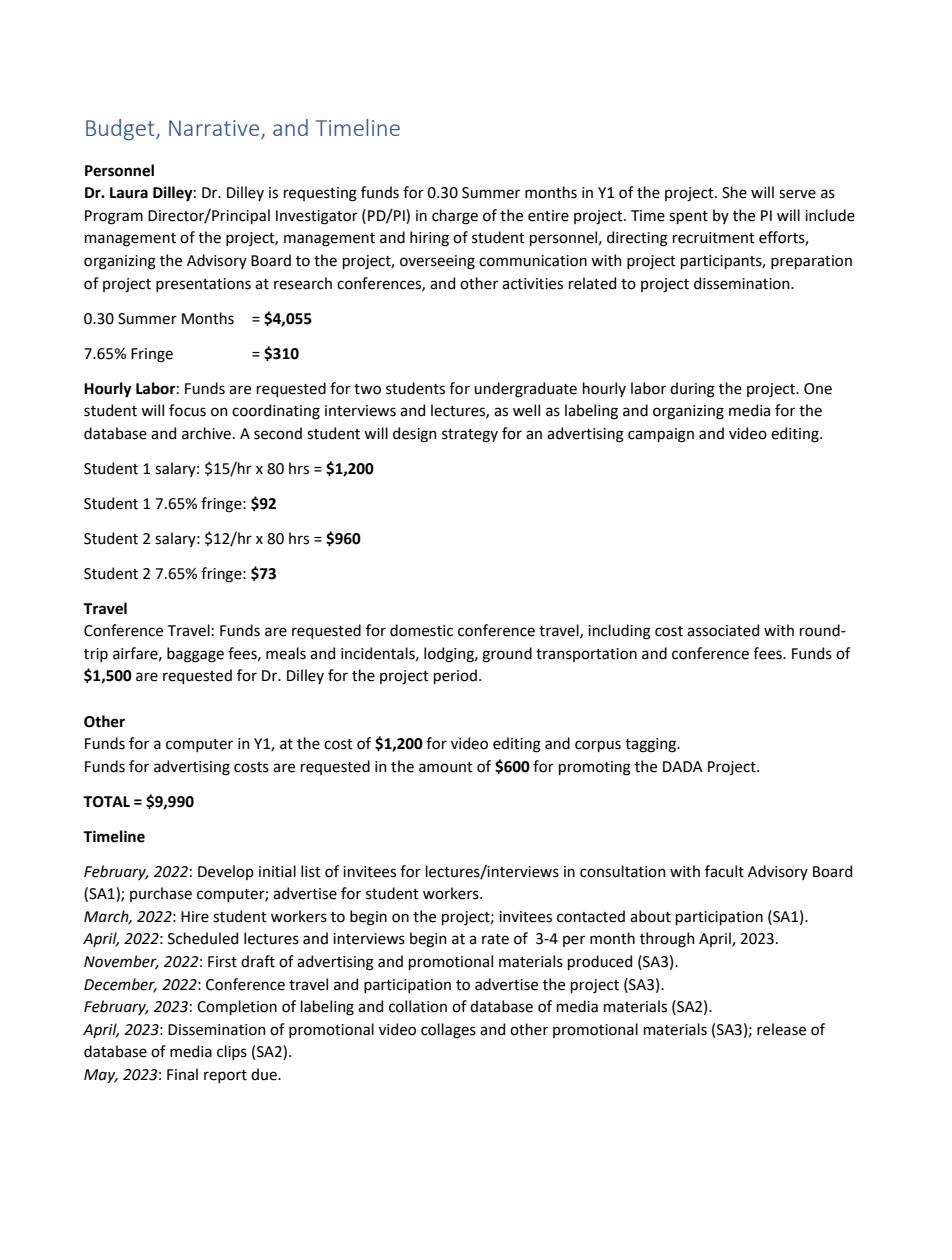
Page 3: I "was an eyewitness to early events associated QAnon," I "began collecting raw footage on social media of Schoenberger and others," and "much of Mr. Tafoya's historical QAnon footage is valuable because it is no longer accessible on the internet." Specific Aim 2 is that footage — to be labelled and organized into a searchable database. Aim 3's promotional collages draw on it. "Mr. Tafoya has graciously agreed to lend his talents."
| Line (as budgeted) | Amount |
|---|---|
| PI summer salary, 0.30 months + fringe | $4,365 |
| PI conference travel | $1,500 |
| Two students, incl. fringe — one to label and organize the media archive | $2,325 |
| Computer, video editing and corpus tagging | $1,200 |
| Advertising | $600 |
| The eyewitness whose archive is Aim 2 | $0 |
| Total | $9,990 |
The speaker list on pages 4–5 includes me, Fox, Cullen Hoback, Jesselyn Radack, Desiree Kane and Steven Hassan — several of whom appear elsewhere in this file. This is the honor trap of chapter 12 in its administrative form: the contribution is structural, the credit is gracious, and the budget is silent.
A year later, the same archive as a book pitch
I hold two of Dilley's Word files. "Book Proposal Notes," saved June 9–10, 2023 (author and last editor in the file: "Dilley, Laura"), and "Book Proposal," dated July 22, 2023, marked partial. The comps in the notes were pulled from Amazon on January 16, 2023 (the timestamps are in the URLs), so the project was already under way then. Both drafts are illustrated with my artwork: 42 images in the notes, 30 in the proposal.
The notes are raw: a title list ("The Professor and the Vampire," "Interview with the Vampire Lestat," "Q: A Love Story"), the pitch lines ("The Da Vinci Code" meets "Don't Look Up"; "The Matrix" meets "Interview with The Vampire"), and an outline taken from the interviews she recorded with me, often close to my own words. The planned opening: "the interviewer (here, Laura) is chatting with the vampire (here, Lestat)."
The proposal six weeks later is the finished pitch. Its title is "Q+, and On Falling For Cicada: A Love Story." In it, in her own words:
- I am "Our Hero," on "a 'David-versus-Goliath' fight to expose" Schoenberger.
- On her paper: "Impressed by Arturo's clues and insights, Dilley incorporates Arturo's findings into her own work."
- Her sources include "Arturo Tafoya's large corpus of rare archival footage which has been collected for five years."
- "A key element of this book is that it will, itself, be an Alternate Reality Game", with the theme "reverse engineering QAnon" and, as options, "in-app purchases for clues."
- "Arturo Tafoya can also provide attractive cover artwork," and "Non-disclosure agreements regarding the book will be secured as appropriate."
Nothing in either draft mentions my share. Set beside the DADA budget above, it is the same pattern: my archive and my story are the product, first as a grant and then as a book. It also fixes, in her own words in July 2023, what she said my work was worth to her paper, before the story was told the other way. The proposal's claims about third parties (Schoenberger's record, the journal's reasons, Russian involvement) are hers and are not adopted here.
Twenty-four hours of credit, then acknowledgments only
Held in the corpus: on December 19, 2021 Dilley posts that she stands with me and my "outstanding contributions"; on December 20, after pushback, that her article did not "cite" me: "His name was mentioned in the acknowledgments. That is all." On July 17, 2022 she credits me publicly as the paper's cover artist.
Moves to Documented when status IDs and absolute timestamps are attached — the file's own rule.
A project member's thread the day after the credit line
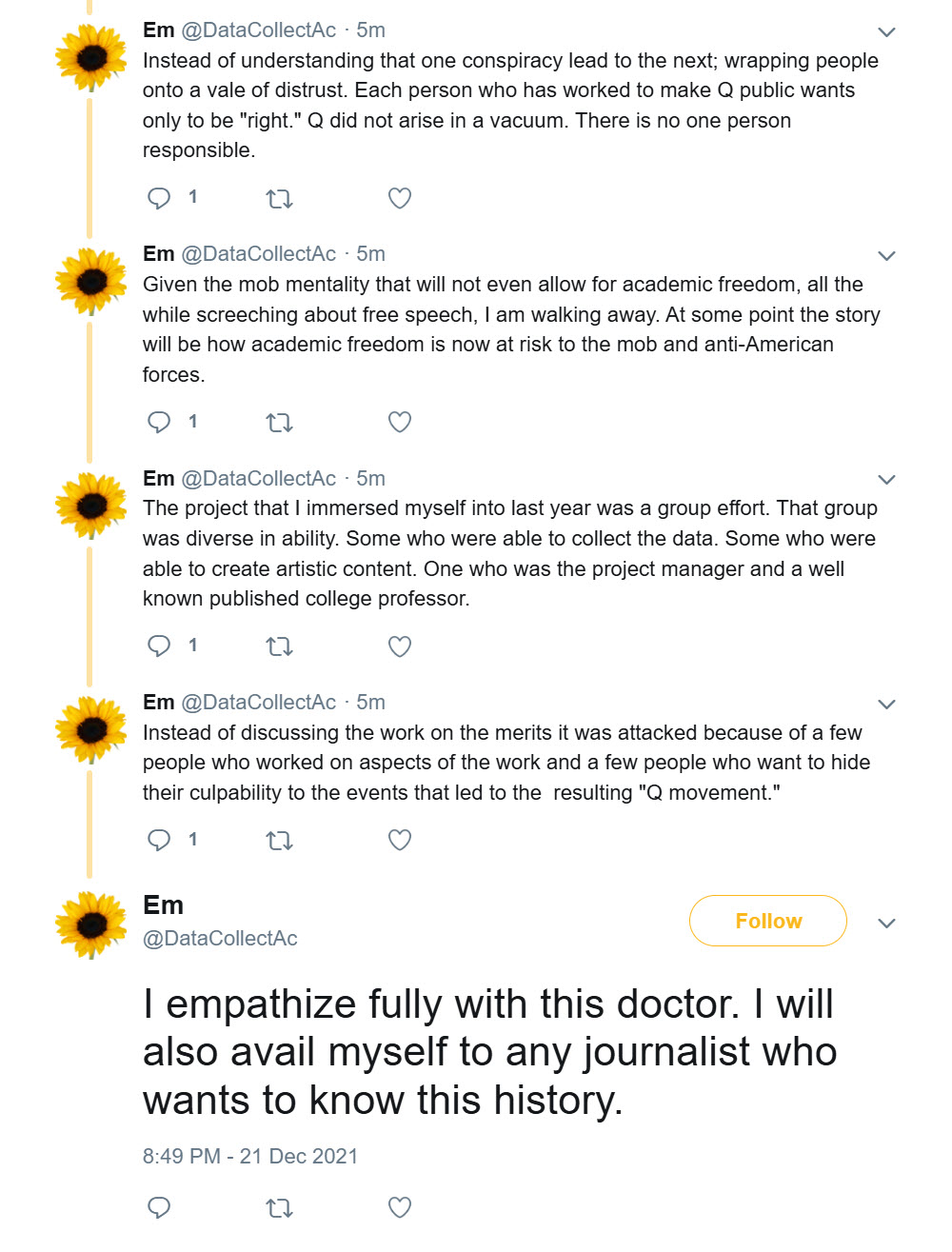
A day after the "acknowledgments" exchange above, a thread from @DataCollectAc says the project "was a group effort," that it included "some who were able to collect the data" and "some who were able to create artistic content," and that it was attacked by "a few people who want to hide their culpability to the events that led to the resulting 'Q movement.'" It also says "there is no one person responsible." The same account appears in the chapter 12 co-occurrence graph.
The thread does not name me. It does describe, in the project's own words, a division of labour between data collection and artistic content.
The NDAs: one-sided, ten years, and they didn't hold
Six non-disclosure agreements issued to sources, all one-sided, with ten-year terms — signatories and recipients including Lisa Derrick, William Welna, Claudia Tietze, Misha Kozak and Cullen Hoback. Farallon is NDA'd into the project as of July 3, 2023. Tietze's copy carries Welna's name, a copy-paste error; Hoback's is unsigned; one is blank.
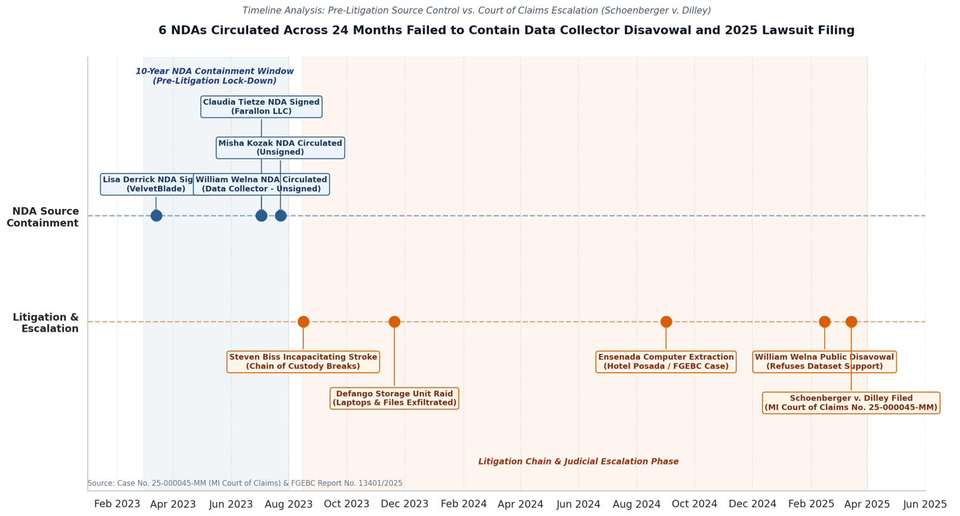
It is a working visualization, not an exhibit. Two labels need checking against the signed copies — the chart pairs "Lisa Derrick" with "VelvetBlade," and marks Welna's NDA "unsigned," where the NDA file lists him among the signatories. The escalation-row events that are not documented elsewhere in this file (the Biss health event, the Charlottesville storage-unit episode) stay at the tier of their own artifacts, whatever the chart implies.
The point the chart makes survives the caveats. Ten-year silence was bought from the people closest to the paper, and within two years its own data collector disavowed it on the record and the plaintiff cited that disavowal in court.
Welna's own account of how he came to the paper
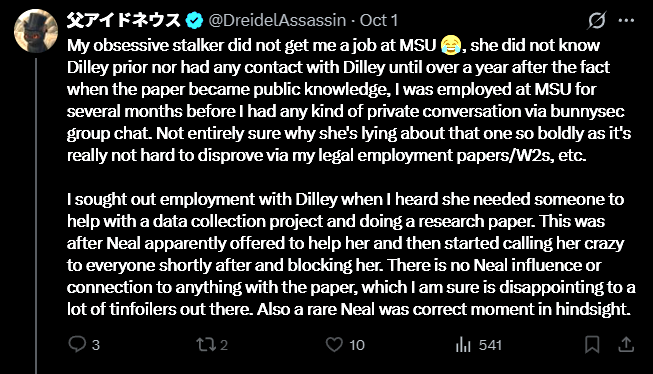
Welna says he was already working at Michigan State "for several months" before any private conversation in a group chat, and that he "sought out employment with Dilley when I heard she needed someone to help with a data collection project and doing a research paper." He says this came after Neal Rauhauser offered to help her and then turned on her, and that "There is no Neal influence or connection to anything with the paper." He says his employment papers would show it.
Filed at his word. It cuts against any reading of him as someone placed in the project from the Rauhauser side, and the same test applies to him as to everyone else here: the employment records he mentions are not in this file.
“Without having to polish and sustain Arturo”
Lisa Derrick signed one of the NDAs in the entry above. In November 2023, in the same window, she and Dilley exchanged direct messages, forwarded to me later, that read as a working plan: how to proceed with the research around me rather than with me, and how to pre-frame me so my account could be set aside if it got in the way. Two phrases are the shape of it; a third is the one that makes the first two readable in only one way.
“push this through without having to polish and sustain Arturo”
// the frame to put on me if asked
[characterizing me to colleagues as a drug addict]
// if the frame holds and the subject goes quiet
“oops” — in context, a possible overdose treated as narratively convenient
Read with what followed. Eleven months later, on October 3, 2024, Dilley (@laura_greenaura) replied to @ultragrift in public using the same drug-addiction framing, now attached to the September 2024 Ensenada incident covered in the entry below. The public line was the private plan, deployed on schedule.
Lisa Derrick is also the recipient paired with “VelvetBlade” on the NDA chart in the previous entry — she was inside the apparatus, not an outside observer. These messages are between two people who had already agreed in writing to keep the research work private.
Private direct messages, forwarded to this desk; original screenshots in the author’s archive. Direct quotations are from the forwarded text; the “drug addict” wording varies message to message, so the characterization is bracketed rather than quoted. Either party may produce her own copy if she disputes the content.
Five weeks before Ensenada: the accusation reversed
Thirty-six days before Sept 1, Dilley and I exchange a thread whose shape is worth marking before the entries that follow. Her subject puts the word “extortion” on me. My reply flips the frame:
Two things get recorded here that matter for the entries below. One, by late July 2024 my computer and a hard drive were, by my own account in writing, not in my possession. Two, Beth (Foxfire2112) was being kept on the thread — I was forwarding the Dilley breakdown to her, two weeks before the Aug 12 WhatsApp entry below and five weeks before the Ensenada entry below.
Dilley ↔ author, Jul 27, 2024, subject “Ill give you 2 more hours just in case you are busy or out,” Foxfire2112 on the thread. My framing of her conduct inside the quoted reply is mine, in a heated email; the exchange is at Documented tier, that framing is not. What is on the record is the exchange and who was on it.
Still in the room, three years on
Dilley to me: "I was just meeting with Farallon helping her with a presentation giving feedback." The Farallon–Dilley working relationship, which the manuscript places as early as 2020, is still active in August 2024 — after the separation, after the NDAs, weeks before Ensenada.
The computer in the room was for music
Hours before the 911 call, I played one of my own songs live on a Launchpad in my room at the Posada Don Fernando, with the computer set up on the desk running the session. Laura filmed it on her phone. Her voice is at the end of the recording, applauding. That is why the computer was in the room, or so I thought. I had no idea what was planned for later that night.
The computer was in the room because she suggested it. By then she could no longer come to my house: my mother would not allow it, after what I went through in the first part of the relationship. So I brought the equipment to the hotel to play for her.
LESTAT Takes Launchpad to the NEXT LEVEL! · 4:18 · YouTube ↗
What is on paper: on September 22, 2024, Dilley filed a copyright takedown against the video when I posted it on X. In that sworn notice she described it as “a man using computer equipment on his desk and lap to make an electronic music song.” I answered with a counter-notice. On September 25, Google processed my copyright request and removed the copy she had used as her evidence. The video has been on my YouTube channel since September 29, 2024; the copy above has cleaned-up audio.
The computer in the room is on the record three ways: the video, Dilley’s own sworn description of it, and her account’s post below saying the emails were found “on Arturo’s computer on Sept. 1, 2024.” The exact date of the video and that she suggested bringing the computer rest on my word. The takedown (X case 0378437340), my counter-notice (Sep 22, 2024), and Google's removal confirmation (case 4-7682000036888, Sep 25, 2024) are in my email; personal addresses and phone numbers in them are not reproduced.
Ensenada, and the posts that changed the story
On September 1, 2024, at a hotel in Ensenada, the desktop computer I had in my room was accessed and emails were taken from it. At 4:42 AM I called 911 from my phone. I have the recording; the file is stamped 4:46 AM local time, when the call ended. On it I tell the dispatcher that someone is stealing my data right now. I do not reproduce the audio, because it carries other people's information. I also filed a complaint with the Baja California state prosecutor's office, and it was registered with a file number (folio). That document is mine and is not reproduced here.
The part that needs no testimony from me is public. The @AdrianeAscended account — one of the three accounts documented in the Dilley network — posted, in its own words:
- Nov 4, 2024, 10:59 PM. A photograph of a screen showing my private inbox, captioned as evidence that Schoenberger was emailing me.
- Nov 15, 2024. A screenshot of a private email captioned as Schoenberger coaching me, "in email discovered on Arturo's computer on Sept. 1, 2024." The account supplied the date, the device, and the word "discovered" itself.
- Dec 19, 2024. "The picture is of a computer screen."
- Jan 26, 2025. "… knows he gave access to his computer."
In ten weeks the story went from "discovered" to "gave access". My phone recorded the call hours after the screen was photographed.
Original posts in the 137-page @AdrianeAscended archive (762 posts as printed on its cover, Jan 2023 – Aug 2025; times are Pacific). Post IDs: 1857341392139239812 (Nov 15), 1869754141888966698 (Dec 19), 1883759572600643926 (Jan 26).
This is also where chapter 12's inversion came from: the emails and PayPal transfers found on that machine were circulated as proof the conflict with Schoenberger had been fake — the infiltration I had declared, in writing, nine months earlier.
What I say happened in the room
I came back to the room and found Laura at my computer, and I called 911. When the officers arrived she told me she had not found anything suspicious and that she trusted me now. I believed her, and I told the officers to go. The next day she was gone, and after she left all I found was a message on a piece of paper. Her posts above are why I no longer believe what she told me that night.
This part rests on my word. The recording of the call and her posts are the documented parts.
The Question She Wouldn't Answer
Aug 19, 2026 · 2:16 · YouTube ↗