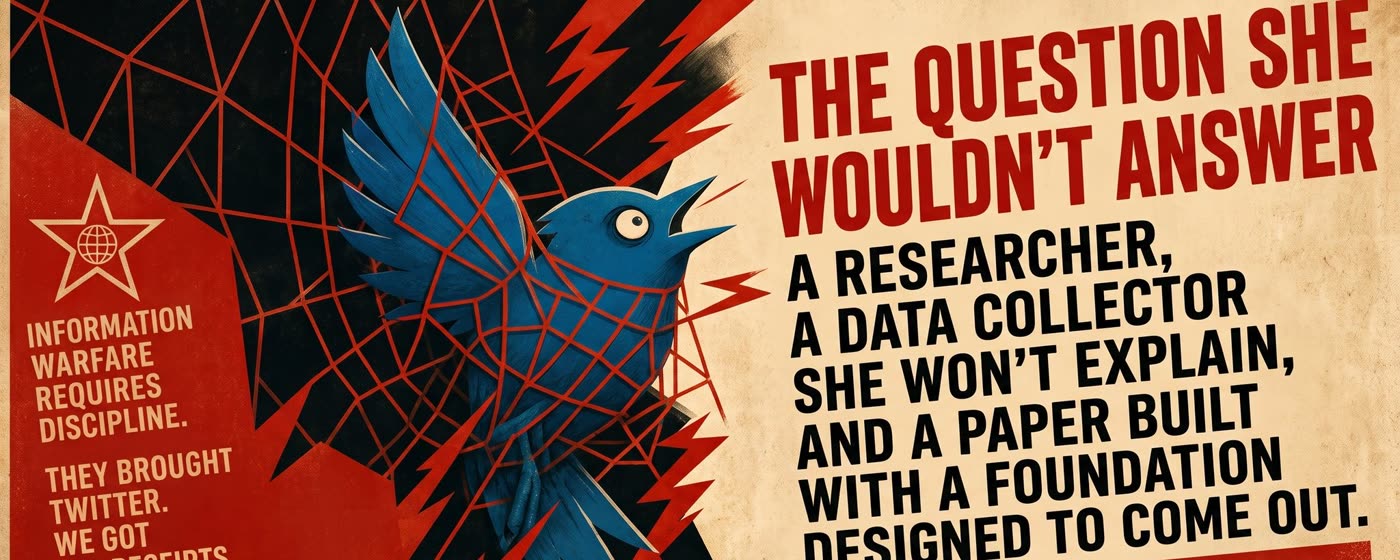
In April 2025, student journalists at The State News asked Laura Dilley a simple question about her QAnon research.
Who is William Welna, and how did you find him?
Welna is not a minor figure in that story. He is the person who collected the Twitter data underpinning her paper — the entire empirical basis of the work. He had no academic research experience. He was listed as a co-author on a paper published under the credibility of a Michigan State University professor.
Dilley declined to explain how she found him.
That refusal has been read as evasiveness about Welna. It isn't. The answer exists; it's in her own words, and it explains not just the paper but the lawsuit that followed it.
I. What her manuscript says
Dilley's own book manuscript describes being recruited into an Anonymous-adjacent intelligence operation run by Neal Rauhauser. It describes her finding William Welna inside Rauhauser's chat rooms.
Set that against what she told The State News: that this was a pandemic hobby. Other people took up knitting or baking; she took up analyzing Twitter data.
These are not two framings of one event. They are incompatible accounts of how the work began. One is a hobby that grew. The other is a recruitment into an existing operation, with a collaborator supplied from inside it.
This is her account, in her own manuscript. Not an allegation about her — a contradiction between two things she has said herself.
And it makes the State News silence legible. She cannot answer "How did you find Welna?" without saying "Neal Rauhauser recruited me, and Welna came out of his chat rooms." The moment she says that, the hobby framing is gone, the independent-researcher framing is gone, and she is a participant in an operation rather than a scholar studying one.
II. Who Rauhauser is
Rauhauser is a documented practitioner of two things that matter here.
The first is ARG-based information warfare — designing alternate reality games that deliberately blur fiction and reality, where participants take real actions against real people while believing they're playing. The design principle is called TINAG: This Is Not A Game. The deniability is structural. It was just part of the game.
The second is lawfare, and he has described the method in his own words:
"We probably need to make a very visible example of at least one of them before the rest understand… The reality of travel, or frightful expenses, or summary judgments needs to be made real" — through "expensive, long distance, lengthy, discovery laden litigation."
That is not a characterization by his critics. That is the stated theory: litigation as a delivery system for cost, aimed at deterrence rather than judgment. Merit is not a variable in it.
He is also, per his own published datasets, deeply invested in this exact terrain — including a set titled 111 QAnon accounts promoting The Storm and 4.3 million tweets on General Flynn and associates.
And per network researcher @nicole_chenelle, Rauhauser operated inside the Discord of Jim Stewartson's "Thinkin Project."
Hold that last one. It matters later.
III. Who Welna is
The person Rauhauser supplied has a documented history that predates the paper entirely.
Per leaked chats documented in the Llama Files — and this is worth noting, because that outlet is broadly hostile to my work, which makes its documentation of Welna adversarially sourced rather than convenient:
Welna communicated with FBI informant Hector Monsegur (Sabu) both before and after Sabu's public outing, continuing at least through May 2012. He admitted to snitch-jacketing Barrett Brown — deliberately planting false information about Brown in forums while in contact with Sabu. Jennifer Emick passed him her FBI handler's phone number.
Sworn affidavits filed under penalty of perjury in Cook County (Case 20222000050) add the financial layer: Welna brokered Joe Fionda's introduction to Louise Mensch in February 2017, and Mensch paid Welna repeatedly for research work, with a PayPal record.
Separately, per @SilkSpectre19, Welna was connected to Libby Shaw through the New Knowledge / Yonder infrastructure via Joohn Choe of Dialectica — a chain that predates the Dilley paper.
And Dilley told me directly that she had Welna on payroll.
So the person who collected the data was not a volunteer programmer who wandered in. He arrived with an operational history, existing paid relationships across the same network, and a documented pattern of feeding information about people he was working alongside.
IV. The anomaly they noticed themselves
In a private conversation, Dilley and her strategic advisor, VelvetBlade, discuss how strange it is that, out of everyone available to Rauhauser, he assigned Welna specifically.
Here's the conversation between Claudia Tieze and Laura Dilley
They noticed. They named it. And nothing changed — Welna stayed on the project, stayed on payroll, and Dilley continued defending him publicly against criticism.
That is the part people misread. It isn't that she failed to see the problem. She saw it, said it out loud in private, and had no move that didn't cost her more than staying put.
V. The exit was pre-written
According to a formal statement attributed to Welna and preserved in the Kaidinin DM archive — single-source, and I flag it as such:
"For the record, William Welna has been a decent person to me. He stated he only did data collection, which is the truth I believe… Should there be litigation in the future, Mr. Welna will not be included as a defendant."
That is pre-lawsuit language. Someone was already mapping the blast radius and placing Welna outside it.
Kaidinin's reading of the whole arrangement is that Welna entered Dilley's operation to relay intelligence to Thomas Schoenberger and Trevor Fitzgibbon, and to get Dilley fired. That is a single source and an interpretation, and I present it as one.
What is not interpretation is what happened next.
Welna publicly disavowed the paper. He said he had believed the work would be "strictly academic" and was disturbed by "trolling, lawfare, and surrounding personal relationship issues." He defended the data while disowning the conclusions.
Schoenberger's side then cited that disavowal as evidence against Dilley in Schoenberger v. Dilley et al., Case No. 25-000045-MM.
VI. The structure, stated plainly
Read the sequence as an engineering problem rather than a personal drama.
Rauhauser recruits the author. Rauhauser supplies the data collector. The data collector — with no academic training and a documented informant-adjacent history — becomes the sole load-bearing element of the paper's empirical claims. The data collector signals in advance that he won't be a defendant. The data collector withdraws. The withdrawal becomes the plaintiff's evidence.
The paper was built with a foundation designed to come out.
I want to be precise about what that sentence claims and what it doesn't. It claims the structure had a removable load-bearing element supplied by an outside party, and that its removal is now functioning as legal ammunition. That is documented at every link.
It does not claim that Rauhauser designed the lawsuit. I don't have that. What I have is a doctrinal signature — a man who published the method, present at the origin of the artifact the method is now being used against. That's a strong pattern. It is not yet an attribution, and I won't publish it as one.
The distinction matters because the documented version is already sufficient.
VII. The paper was in trouble before any of this
None of the above requires the paper to have been good.
Frontiers in Communication accepted it in September 2021, then rescinded the acceptance entirely after two months of review, finding it violated policy on ascribing negative labels to individuals without their consent. A journal withdrew a paper it had already accepted. Dilley said the journal had been "harassed into submission" and posted it to arXiv, which has no peer review.
She identified people as QAnon insiders on what she has acknowledged was an educated guess. She labeled Trevor Fitzgibbon a QAnon supporter despite his having written against the conspiracy. She labeled Suzie Dawson an insider when, per Yale Law's Sean O'Brien, Dawson was among its earliest detractors.
She bound six sources — Lisa Derrick, William Welna, Claudia Tietze, Misha Kozak, Cullen Hoback, and Javier — under ten-year one-sided NDAs. None bound her.
So the paper was ethically compromised on its own terms, independent of who supplied the data. The Welna structure didn't create the vulnerability. It guaranteed the vulnerability would be actionable.
VIII. Why nobody talks
The question I kept returning to was why anyone participates in litigation with no foundation.
The answer is in Dilley's silence, and it generalizes.
Her strongest defense is "I was recruited into an operation by Neal Rauhauser and handed a collaborator from his chat rooms." That defense is true; it's in her own manuscript, and it would probably help her legally.
Please visit this link about Dilley and Claudia, after that think about how is it possible that Claudia is now a witness in Thomas favor.
She can't use it. Because it destroys her more completely than losing the case does. It converts her from a researcher with methodology problems into a participant in an information operation who published under a university's name.
Her exculpatory fact is more expensive than the judgment.
Once you see that, the whole question dissolves. Nobody is playing along out of loyalty or coordination. Each participant is holding something that costs more to say than to litigate. Silence isn't complicity — it's arithmetic. And a lawfare model built on cost rather than merit doesn't just tolerate that dynamic. It runs on it.
IX. The thing about Stewartson
One more piece, offered as an open question rather than a conclusion.
Schoenberger litigates widely. He does not go after Jim Stewartson — who built a public platform on this exact material.
Rauhauser was inside Stewartson's TTP Discord.
I'm not asserting what that means. I'm noting that the man who supplied Dilley's data collector was operating inside the project of the one person in this space who never seems to draw fire. The pattern of who doesn't get sued is, in a lawfare model, at least as informative as the pattern of who does.
X. What is this
Everything above rests on: Dilley's own book manuscript; her own statements to The State News; sworn affidavits filed under penalty of perjury in Cook County; leaked chats documented by an outlet hostile to me; PayPal records; a rescinded journal acceptance; six NDAs I have copies of; a court docket; and Rauhauser's own published words about his method.
Where a claim rests on a single source — Kaidinin, @SilkSpectre19, @nicole_chenelle — I've named the source and marked it. Where something is an inference, I've said it's an inference and declined to promote it.
I've spent close to ten years on this. The temptation to overstate is constant, and I've watched what it costs the people who give in to it. So the version above is the conservative one, and the conservative one is still this bad.
Dilley was asked one question by student journalists and wouldn't answer it.
This is what the answer was.